Skunk Fish
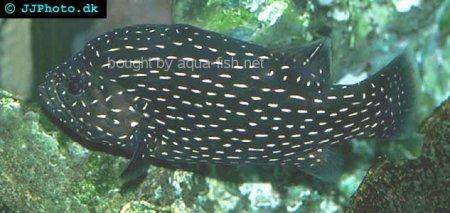
This marine aquarium fish is known as Golden Stripe Soapfish Grouper, Skunk Fish and the correct latin name is Grammistes sexlineatus. The family that this fish belongs to is called the Grouper family. (e) It's origin is Sri Lanka. (e)
Skunk Fish can grow up to 30 cm what is approximately 11 inches. 1 specimen basically needs at least 3600cm2 of water surface which is approximately 558 square inch. It is recommended to raise this species in fish tanks that are large. (e) Medium aquariums have at least 113 Litres (30 US Gallons). Large aquariums have at least 265 Litres (70 US Gallons). Capacity of very large aquariums is at least 700 Litres (185 US Gallons).
It is difficult to keep the Skunk Fish. (e) The specific gravity (SG) should be between 1,020 and 1,025, the temperature between 23°C (73.4°F) and 26°C (78.8°F). The suggested level of pH (a measure of the acidity/basicity) is between 8.0 and 8.3 which is usual for most marine fish.
Click on the image for larger version.
Related fish profiles in the database
Feel free to share your experiences regarding keeping Grammistes sexlineatus below. Every message will be held for approval by our moderators. It usually takes 24 hours to publish your comment. Before you ask anything, browse the questions page, please.
Character and suggestions regarding care
Aggressive and poisonous fish. Not recommended for beginners at all.Skunk Fish can grow up to 30 cm what is approximately 11 inches. 1 specimen basically needs at least 3600cm2 of water surface which is approximately 558 square inch. It is recommended to raise this species in fish tanks that are large. (e) Medium aquariums have at least 113 Litres (30 US Gallons). Large aquariums have at least 265 Litres (70 US Gallons). Capacity of very large aquariums is at least 700 Litres (185 US Gallons).
It is difficult to keep the Skunk Fish. (e) The specific gravity (SG) should be between 1,020 and 1,025, the temperature between 23°C (73.4°F) and 26°C (78.8°F). The suggested level of pH (a measure of the acidity/basicity) is between 8.0 and 8.3 which is usual for most marine fish.
Click on the image for larger version.

Related fish profiles in the database
- Cephalopholis Cyanostigma (Bluespotted Hind)
- Cephalopholis Formosa (Bluelined Hind)
- Cephalopholis Miniata (Miniatus Grouper, Coral Hind)
- Cephalopholis Sexmaculata (Sicblotch Hind)
- Cromileptes Altivelis (Panther Grouper)
- Epinephelus Aeneus (White Grouper)
- Epinephelus Areolatus (Areolate Grouper)
- Epinephelus Flavocaeruleus (Blue And Yellow Grouper)
- Epinephelus Lanceolatus (Queensland Grouper)
- Epinephelus Marginatus (Dusky Grouper)
- Epinephelus Merra (Honeycomb Grouper)
- Epinephelus Quoyanus (Longfin Grouper)
- Plectropomus Laevis (Blacksaddled Coralgrouper)
- Plectropomus Maculatus (Spotted Coralgrouper)
- Variola Louti (Yellow-Edged Lyretail)
- Saltwater aquarium heater
- Saltwater aquarium lights
- Saltwater aquarium filters
- Saltwater tank aeration
- Marine fish diseases
- Protein Simmers in the Saltwater Tank
- Setting up a Saltwater Tank
- Saltwater Fish Tanks
- Cleaner Shrimp
- Pajama Cardinals
- Banded Butterflyfish
- Black-Ray Goby
- Blue-Banded Goby
- Blue Chromis
- Blue Green Chromis
- Blue Spot Butterflyfish
- Breeding Seahorses
- Cleaning Goby
- Common Seahorse
- Domino Damselfish
- Dragonface Pipefish
- Drawf Seahorse
- Fire Goby
- Ghost Pipefish
- Golden Damselfish
- Humbug Damselfish
- Lemonpeel Dwarf Angelfish (Centropyge flavissima) Care
- Longfin Bannerfish
- Majestic Angelfish Care
- Neon Velvet Damselfish
- Northern Seahorse
- Pyramid Butterflyfish
- Spotted Watchman Goby
- Tips on Yellow Longnose Butterflyfish Care
- Two Spot Goby
- Yellow Longnose Butterflyfish
Feel free to share your experiences regarding keeping Grammistes sexlineatus below. Every message will be held for approval by our moderators. It usually takes 24 hours to publish your comment. Before you ask anything, browse the questions page, please.
Document modified on Tue Dec 11 12:05:09 UTC 2007
Document created on Tue Dec 11 12:05:09 UTC 2007
How to cite this page? Use the following HTML:
edit this page or create a new fish profile "Skunk Fish." saltwater.aqua-fish.net. Tue Dec 11 12:05:09 UTC 2007.
Aqua-Fish.Net. Sat Jul 19 0:00:39 UTC 2025 https://saltwater.aqua-fish.net/?skunk-fish.